

- REATIL & CONSUMER
- SITE & EXPANSION DECISIONS
- ENTERPRISE
Powering global store growth and performance decisions for Starbucks

Where should the next store be built? Which locations are cannibalizing each other’s sales? Which sites are due for a remodel or relocation? These are the kinds of questions Starbucks has been asking Integral to help answer for over two decades.
Integral partnered with Starbucks to build a complete geospatial data fabric of their global store network and a suite of analytical applications that interface with Starbucks’ broader data infrastructure. The result is an enterprise platform that gives Starbucks’ teams the spatial intelligence to make confident decisions about where to grow, what to sell, and how to manage performance across thousands of locations worldwide

25+
years of partnership supporting global store growth decisions
1,000+
users across the Starbucks organization
1
global system of record
-
Define the decision
Starbucks makes some of the most consequential location decisions in global retail. With thousands of stores across dozens of markets worldwide, the decisions compound quickly:
- Where should the next store open?
- Which existing locations are cannibalizing nearby store sales?
- Which sites are underperforming and why?
- Which locations are due for a remodel or relocation?
- How do local market conditions, competitor locations, and customer behavior factor into each decision?
Those decisions were being made across a growing, global organization without a unified spatial platform to support them. Store data, sales performance, competitor locations, lease information, and market intelligence existed across separate systems with no shared analytical environment connecting them.
The decision to solve:
How can Starbucks bring together location data, sales performance, market intelligence, and competitor analysis into one unified platform that gives their teams the clarity to make confident decisions about where and how to grow?
-
Design the system
Integral worked closely with the Starbucks development team to design a system built around the full complexity of global retail site strategy. The starting point was data — gathering, standardizing, and weaving together Starbucks’ store locations, competitor locations, sales assets, and market information into a comprehensive geospatial data fabric.
The system design focused on these core needs:
- Provide a common, global interface that can support multiple languages
- Understanding where new stores should go
- Understanding how existing stores were performing relative to each other
- Connecting all of that intelligence to Starbucks’ broader data infrastructure so decisions could be made with confidence across the organization.
Integral built and iterated a suitability model against historical sales data to verify accuracy and identify the variables that most influenced new store success — giving Starbucks an analytical foundation grounded in real performance data rather than assumptions.
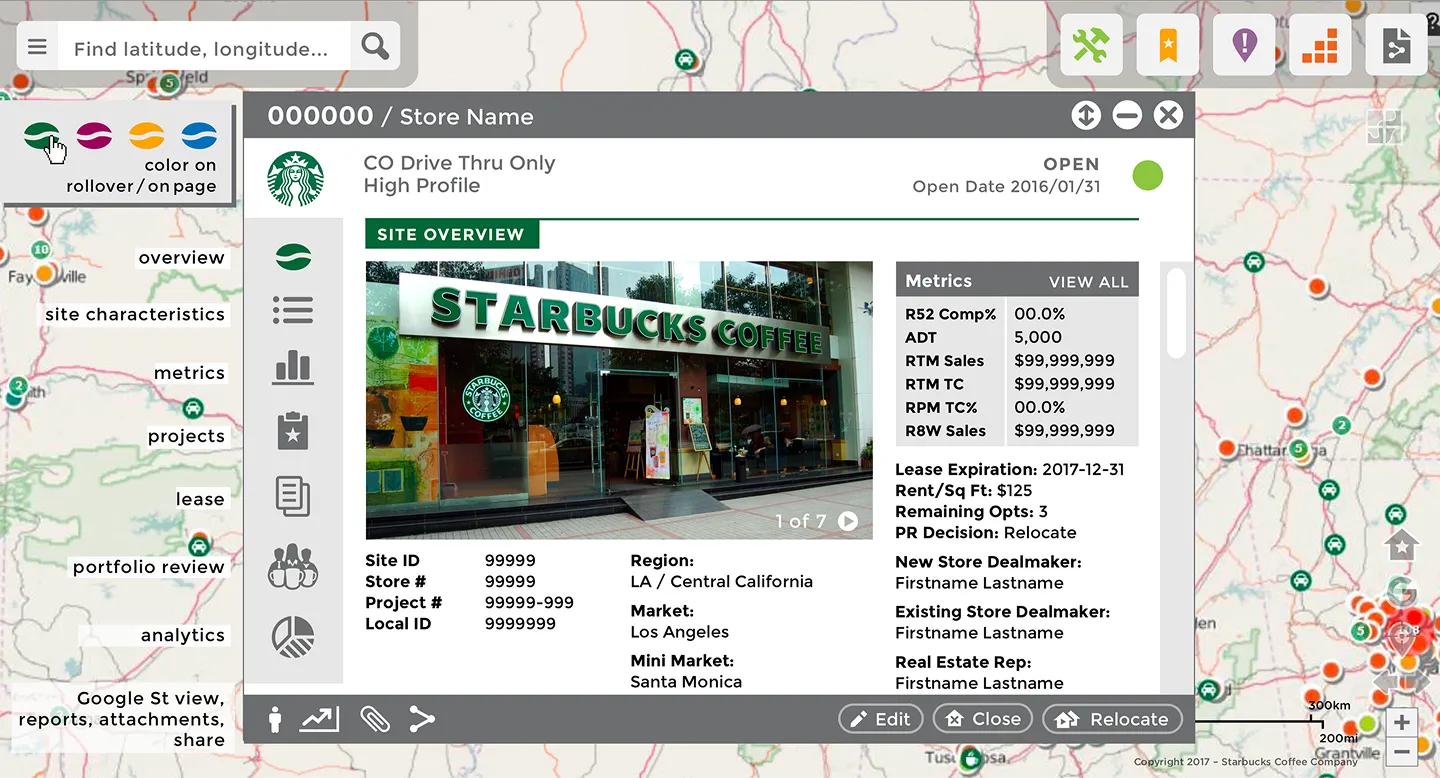
A unified store profile giving Starbucks teams a single view of site characteristics, performance metrics, lease details, and location context for every store in the network. -
Build the platform
Integral built a suite of analytical applications on top of a comprehensive geospatial data fabric, designed to interface directly with Starbucks’ broader data infrastructure and serve over 1,000 users across the organization.
Core platform capabilities included:
- Multiple languages supporting a global user base
- A global store and competitor location database with detailed site characteristics, lease attributes, and performance metrics
- Retail suitability modeling using spatial analyst to identify optimal new store locations across metropolitan statistical areas
- Sales cannibalization analysis identifying where existing stores were competing with each other
- Store performance comparison tools with year over year sales, transaction, and revenue metrics
- Lease management and portfolio review tools tracking expiration dates, rent, and relocation decisions
- A portfolio refresh tool connecting interior design elements and remodel decisions to specific store locations
- Pipeline and project tracking for new store development and renovation activity
- Batch processing of metropolitan statistical areas across the entire country saving many months of personnel time
- Integration with Starbucks’ broader data infrastructure for organization-wide reporting
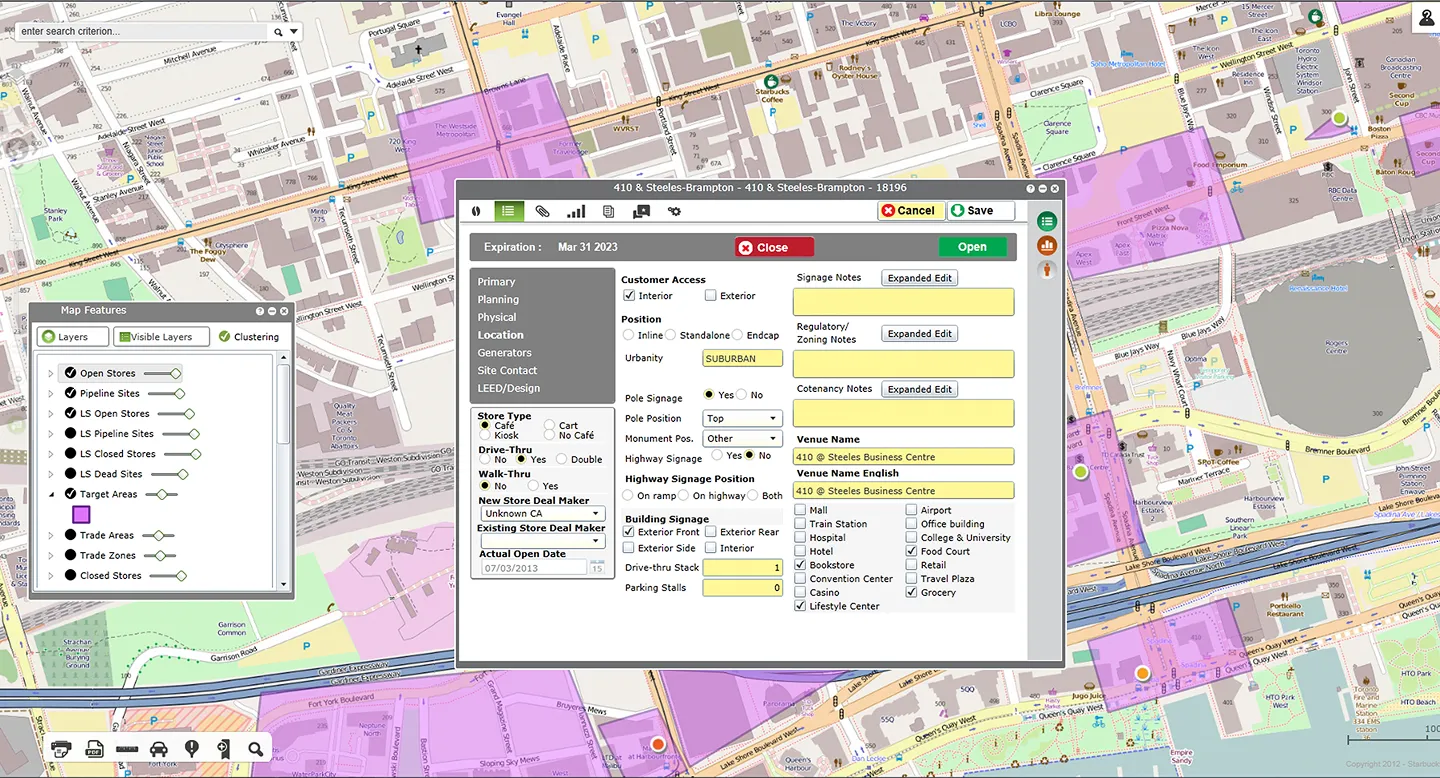
Detailed site data capturing store type, signage, access, zoning, and lease information, giving Starbucks teams everything they need to evaluate, manage, and make decisions about individual locations at a global scale. -
Deliver the insight
Integral gave Starbucks a spatial lens backed by hard data to make clear, confident decisions about where to locate, what to sell, and how to spot problems across a global store network.
The platform enabled:
- Identification of optimal new store locations across every metropolitan market in the country
- Detection of sales cannibalization between existing stores before it became a costly problem
- Store performance comparison across markets, regions, and store types giving leadership a unified view of the portfolio
- Faster, more accurate site analysis saving many months of personnel time through batch processing
- Robust, organization-wide reporting through direct integration with Starbucks’ data infrastructure
- Confident lease and relocation decisions grounded in spatial performance data
What started as a site suitability model grew into the analytical backbone of how one of the world’s most recognized retail brands decides where and how to grow.
-
Support real-world use
Integral’s partnership with Starbucks spanned more than two decades — one of the longest and most expansive client relationships in Integral’s history. What began as a retail suitability model evolved continuously as Starbucks grew, adding new analytical capabilities, new data sources, and new applications as the business scaled globally.
The impact extended well beyond site selection:
- Starbucks established a unified spatial platform that touched every stage of the store lifecycle, from site identification to lease management to performance review
- Analysts across the organization gained a shared analytical environment that saved months of personnel time through automation and batch processing
- Leadership gained confident, data-driven visibility into a global portfolio spanning thousands of locations
- The platform grew and evolved alongside the business, adding capabilities as new questions emerged
Our long-term geospatial partnership with Starbucks extended far beyond a suite of applications. Our collaboration produced the spatial intelligence layer for the world's largest coffeehouse brand.
Complex problems deserve purpose-built solutions.
Understanding your challenge is step one. Tell us what you're working on and discover how we can work together to figure out the right solution.