
- ENERGY & UTILITIES
- REAL-TIME OPERATIONAL VISIBILITY
- TRANSMISSION OPERATIONS
Transforming grid situational awareness for PJM dispatch operations

PJM Interconnection, operator of the largest electric grid in the country and the largest RTO in the world, is responsible for maintaining grid reliability for more than 61 million people across 13 states and Washington, DC. Dispatchers and operators need to continuously monitor transmission infrastructure, outages, weather events, generation resources, and system conditions in real time to keep the grid stable and responsive.
That journey began with the data. Integral worked with PJM’s planning department to convert paper one-lines, Visio diagrams, and Excel files into a comprehensive geodatabase – a structured, spatial model of every transmission asset under PJM’s purview. With that foundation in place, we partnered with PJM’s operations to build DIMA (Dispatch Interactive Map Application): a real-time operational mapping platform that enables dispatchers, engineers, and planners to visualize, analyze, and respond to changing grid conditions through a unified geospatial interface.

61M+
customers supported
10K
mapped lines, substations, and assets
130
unique users and growing
-
Define the decision
PJM dispatchers and grid operators make high-stakes operational decisions every minute.
- Which outages pose reliability risks?
- Where are severe weather conditions impacting infrastructure?
- How is power flowing across the transmission network?
- Which substations, generators, or reactive resources are affected?
- Where should load be redistributed to maintain system stability?
But before those operational decisions could be supported, a more foundational problem had to be solved. PJM’s transmission asset information was scattered across paper one-line diagrams, Visio schematics, and Excel spreadsheets – each maintained by different transmission owners to different standards. The teams across PJM didn’t have standard terminology, diagrams, or a system to communicate and track their assets.There was no single, authoritative model of the grid that the organization could align around or build on.
The decision to solve first:
How do you standardize, reconcile, and spatially model an entire transmission system so that PJM could communicate clearly internally and build toward long-term operation capabilities?With that foundation in place, the next decision could be addressed: how can PJM’s dispatch operations move from siloed tools and disconnected data views to a unified geospatial environment that gives operators an understanding of how weather, outages, telemetry, substations, and transmission infrastructure interacted in real time?

PJM dispatchers at work in one of the most consequential control rooms in the country, managing grid reliability for the largest competitive electricity market in the world. -
Design the system
Integral partnered closely with PJM to capture their assets and design a system to centralize operational awareness while allowing dispatchers and engineers flexibility in how information was visualized and analyzed. The dispatchers themselves were involved in the design process so we could guide us to build to their real-world needs.
Key priorities included:
- One authoritative record of transmission assets
- Standardizing terminology and diagrams
- Real-Time situational awareness
- Integration of operational and geospatial data
- Weather-aware operational monitoring
- Flexible, user-controlled visualizations
- Support for both operations and long-term planning workflows
The result for the planning department was a single, governed geodatabase of every transmission asset under PJM’s purview, with standardized terminology and diagrams that teams across the organization could align around.
The resulting platform embedded geospatial intelligence directly into dispatch operations rather than threatening GIS as a separate reference system.
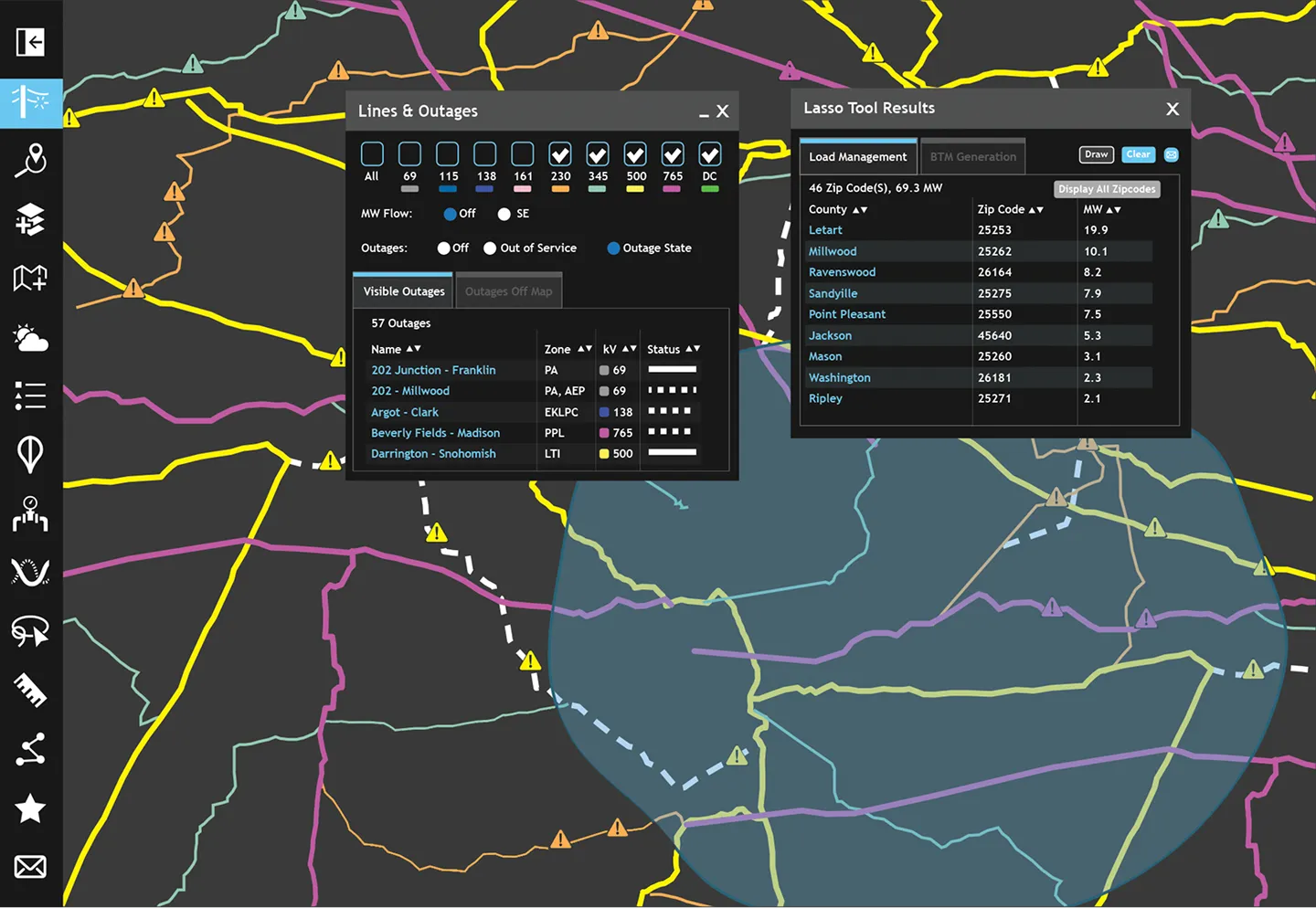
Live weather data mapped against the grid, so operators can see developing conditions and implement contingencies before they become disruptions. -
Build the platform
On the data backbone of the comprehensive, unified geodatabase, Integral designed and developed DIMA as a real-time operational mapping platform purpose-built for dispatch operations.
Core platform components included:
- Real-Time transmission line and outage visualization
- Substation status monitoring and equipment detail views
- Synchrophasor and PMU integration
- Weather radar, alerts and forecasting overlays
- Gas pipeline visibility and dependency analysis
- Schematic transmission network views
- Animated voltage flows
- Interactive filtering, search, and map-layer controls
- Historical and live operational data integration
- Demand response and load management tools
- Operational scenario visualization capabilities
The platform integrated data from EMS systems, SCADA telemetry, OSIsoft PI System, ArcGIS services, weather feeds, and equipment outage management systems into a continuously updating operational environment.
DIMA was designed to operate as both a geographic and schematic representation of the grid, enabling dispatchers to seamlessly move between spatial context and simplified network connectivity views depending on operational needs.
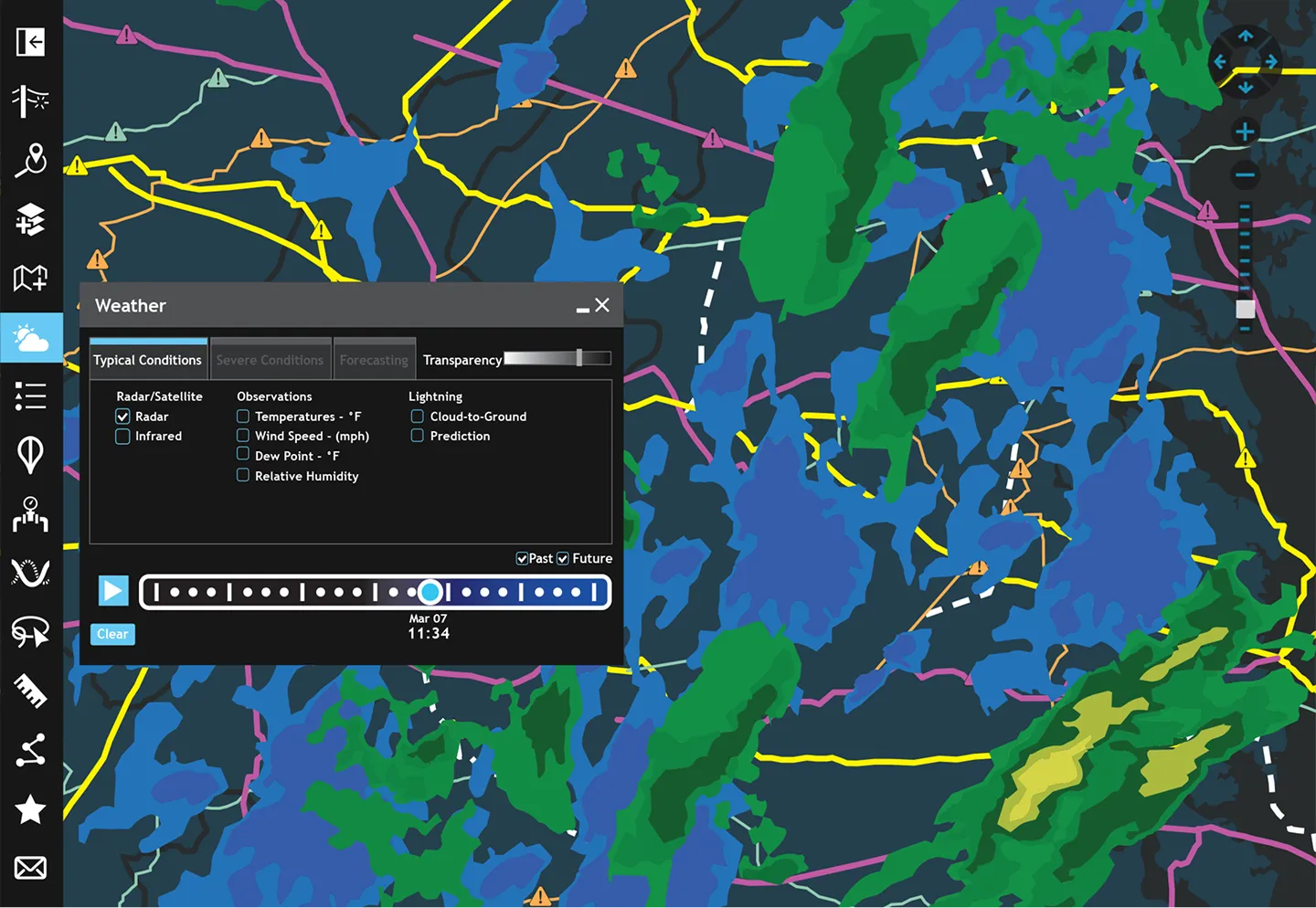
Live weather radar overlaid on the transmission network, giving dispatchers past and future conditions in one operational environment. Operational awareness shifted from fragmented
to unified. -
Deliver the insight
DIMA transformed how PJM dispatchers, operators, and planners interact with operational grid information:
- Standardized communication about transmission assets across the organization
- Established an authoritative record of assets, relationships, and connectivity
- Unlocked the foundation for future digital operational solutions
- Delivered real-time awareness of outages, weather, and system conditions
Operational awareness shifted from fragmented to unified.
-
Support real-world use
Dispatcher involvement didn’t begin at launch — it began at design. By keeping PJM’s dispatch teams hands-on throughout the development process, the platform was built around real operational needs rather than assumed ones. That early buy-in translated directly into adoption.
DIMA evolved continuously through iterative releases as operational needs grew. The impact extended beyond the platform:
- Dispatchers gained a trusted, unified view of the grid for the first time
- PJM established a reusable data foundation for future digital solutions
- Operational awareness shifted from reactive and fragmented to continuous and unified
- Adoption grew organically as the platform proved its value in real dispatch operations
Serving as PJM's operational backbone, DIMA dramatically improves visibility and management of a grid counted on by millions of Americans.
Complex problems deserve purpose-built solutions.
Understanding your challenge is step one. Tell us what you're working on and discover how we can work together to figure out the right solution.