
- TECHNOLOGY
- SITE & EXPANSION DECISIONS
- INFRASTRUCTURE INTELLIGENCE
Ensuring performance and long-term viability for Microsoft Azure through optimal data center location decisions

As Microsoft continued to expand its Azure cloud offerings, finding the right locations for new data centers around the world became a critical strategic challenge. The decisions involved dozens of competing factors including land quality, power availability, water and sewer access, fiber infrastructure, tax incentives, and geopolitical risk.
Integral partnered with Microsoft to build Microsoft ATLAS, a global site intelligence platform that established a unified dataset of existing Azure data center locations and built a scoring and comparison system to identify and evaluate optimal new sites worldwide. With ATLAS in place, Microsoft’s teams could make strong, data-based judgments about where to locate the infrastructure powering one of the world’s largest cloud networks.

1,000+
data centers mapped
100+
potential site recommendations
100+
countries assessed for data center suitability
-
Define the decision
Microsoft Azure depends on a global network of data centers to deliver cloud services to customers around the world. As Azure’s capabilities and capacity expanded, so did the need to identify new data center locations that could support that growth reliably and sustainably.
The decisions Microsoft needed to make were complex and high stakes:
- Where should the next data center be located?
- Which candidate sites offer the right combination of power, water, fiber, and land availability?
- How do tax incentives, geopolitical risk, and infrastructure quality factor into the comparison?
- How do we evaluate dozens of potential sites across multiple countries consistently and confidently?
Prior to ATLAS, those decisions were being made without a unified spatial framework for evaluating and comparing candidate sites at a global scale. There was no single environment where all of the relevant factors could be assessed side by side.
The decision to solve:
How can Microsoft bring together the data, criteria, and analytical tools needed to identify and compare optimal data center locations anywhere in the world?
-
Design the system
Integral partnered with Microsoft to design a system that could support one of the most consequential infrastructure decisions a technology company makes — where to locate the physical backbone of a global cloud network.
The design started with establishing a foundation. Before any site could be evaluated, Microsoft needed a complete, authoritative dataset of their existing Azure data center locations worldwide. That data fabric became the baseline against which all future expansion decisions would be made.
From there the system was designed around a core principle: complex, multi-factor site decisions require a consistent, governed framework for evaluation. Every candidate location needed to be assessed against the same criteria, scored the same way, and compared in the same environment so that Microsoft’s teams could make confident, data-based judgments rather than relying on inconsistent, ad hoc analysis.
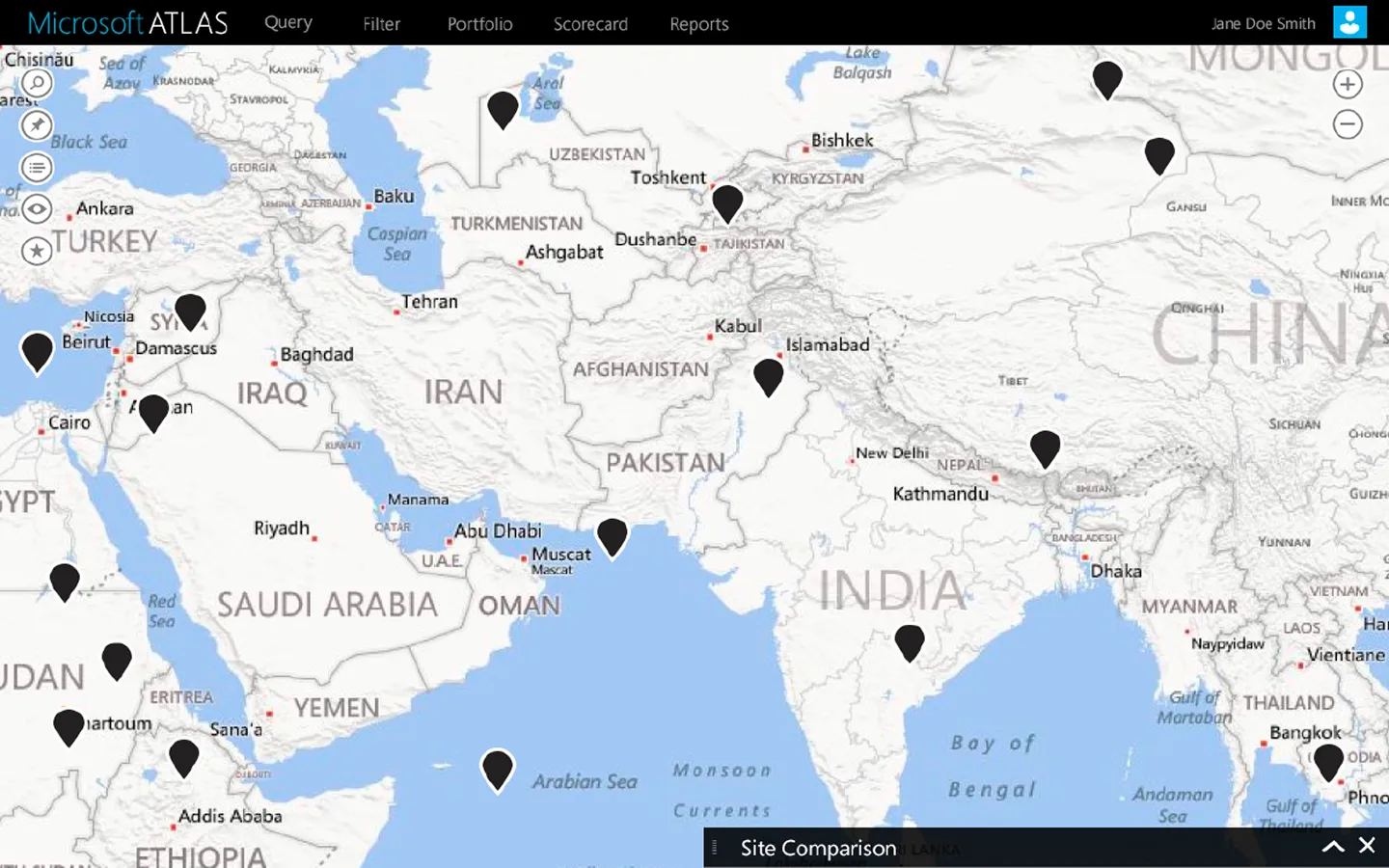
A global map of existing and candidate data center locations giving Microsoft’s site selection team a shared spatial foundation for every expansion decision -
Build the platform
Integral designed and built Microsoft ATLAS, a global site intelligence platform purpose-built for data center location decisions at enterprise scale.
The platform was built on a comprehensive global dataset of existing Azure data center locations, establishing an authoritative spatial foundation for all future expansion decisions. On top of that foundation, ATLAS delivered a structured site evaluation and comparison environment where Microsoft teams could assess candidate locations against a consistent set of weighted criteria including land quality, power availability, water and sewer access, fiber infrastructure, tax incentives and geopolitical risk.
Core platform capabilities included:
- a global map of current and candidate data center locations
- a multi-criteria scoring algorithm for evaluating and ranking candidate sites
- side by side site comparison tools for evaluating multiple locations simultaneously
- flexible query and filtering tools for defining custom search criteria
- portfolio and scorecard views for tracking and reporting on candidate sites across geographies
ATLAS also laid the groundwork for the next phase of Microsoft’s data center intelligence needs, exploring how to monitor the health of individual servers and data centers down to the square foot anywhere in the world.
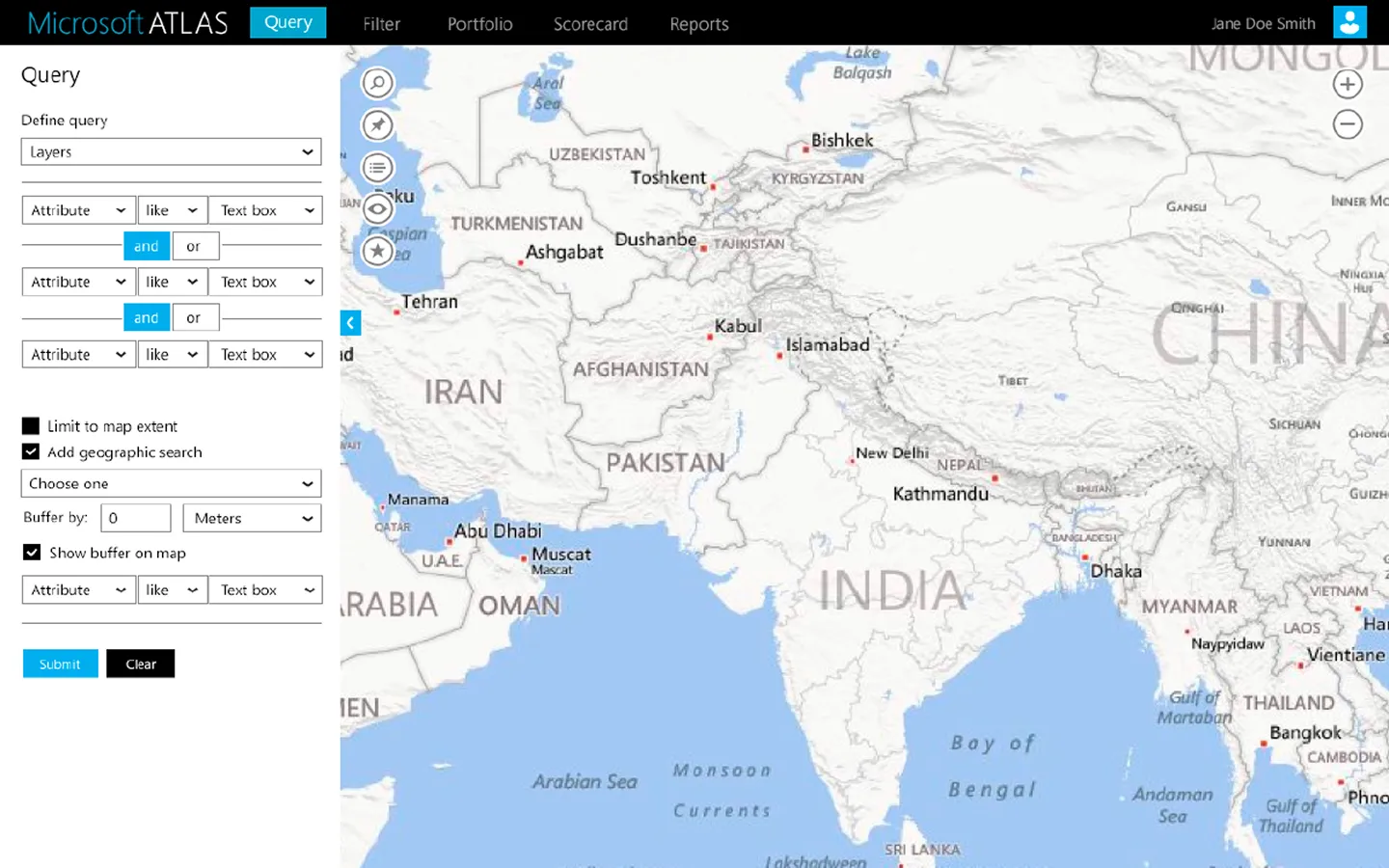
A flexible query builder letting Microsoft’s team define custom search criteria and filter candidate locations across any combination of attributes, anywhere in the world. -
Deliver the insight
With ATLAS in place, Microsoft’s teams had a single, authoritative environment for making data center location decisions at a global scale. What previously required ad hoc analysis across disconnected data sources could now be done consistently, comparably, and confidently from one platform.
The platform enabled:
- Consistent, multi-criteria evaluation of candidate data center locations worldwide
- Side by side site comparison across dozens of locations in a single environment
- Data-based location decisions grounded in a governed spatial framework
- A complete authoritative model of the existing Azure data center network
- A foundation for future server and data center health monitoring down to the square foot
ATLAS transformed how Microsoft approaches one of its most consequential infrastructure decisions, bringing the clarity of spatial intelligence to a problem of genuinely global scale.
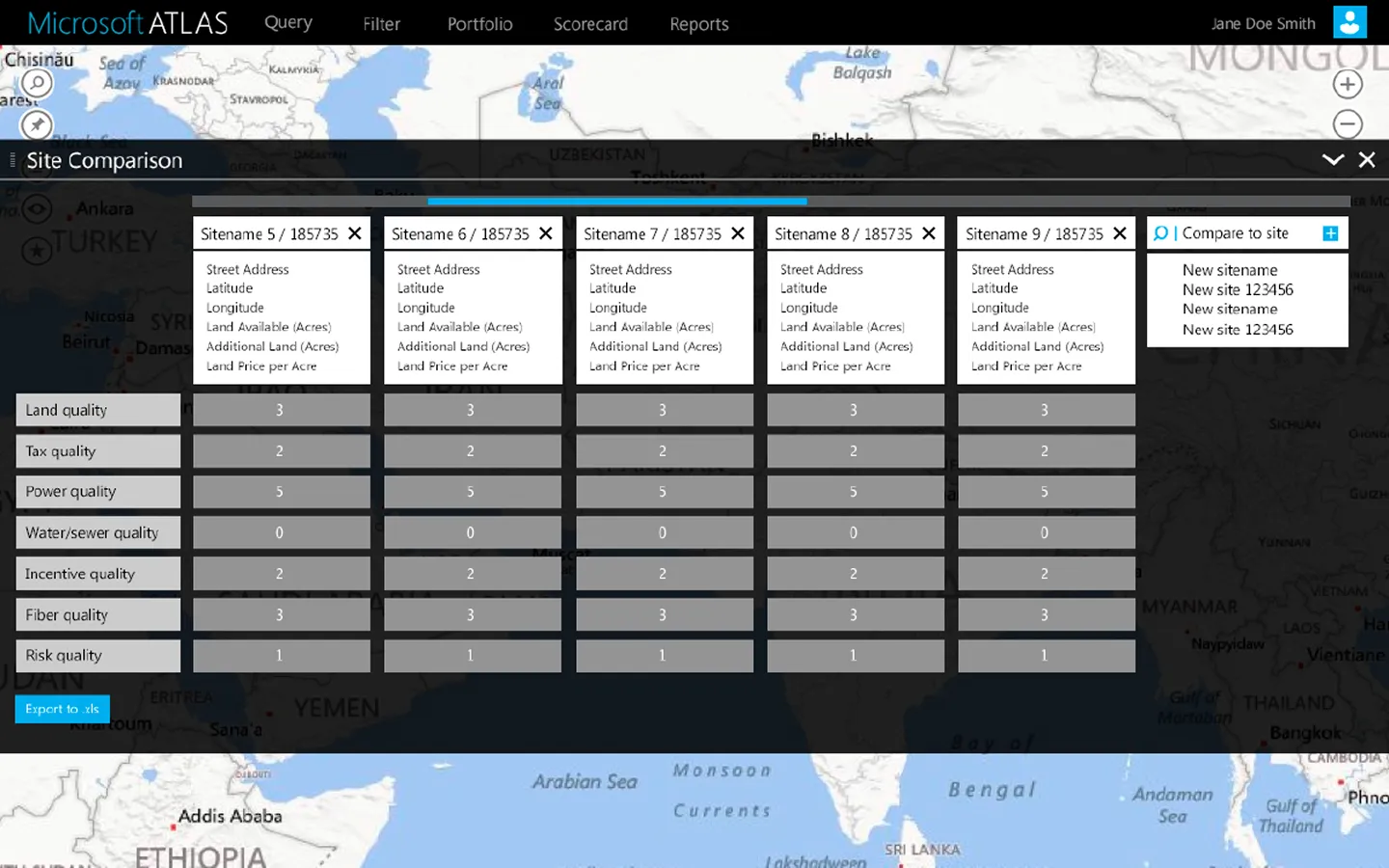
Side by side site comparison scoring candidate locations across land quality, power, water, fiber, tax incentives, and risk, giving Microsoft’s team a consistent, data-driven framework for confident location decisions. -
Support real-world use
ATLAS was adopted by the team that needed it most — the group at Microsoft focused on data center site selection. For the decision makers it was built for, it became the go-to environment for evaluating and comparing candidate locations worldwide.
This foundational decision system was built and documented for autonomy, equipping Microsoft's team with the tools and insight to operate and evolve the platform on their own.
Complex problems deserve purpose-built solutions.
Understanding your challenge is step one. Tell us what you're working on and discover how we can work together to figure out the right solution.